

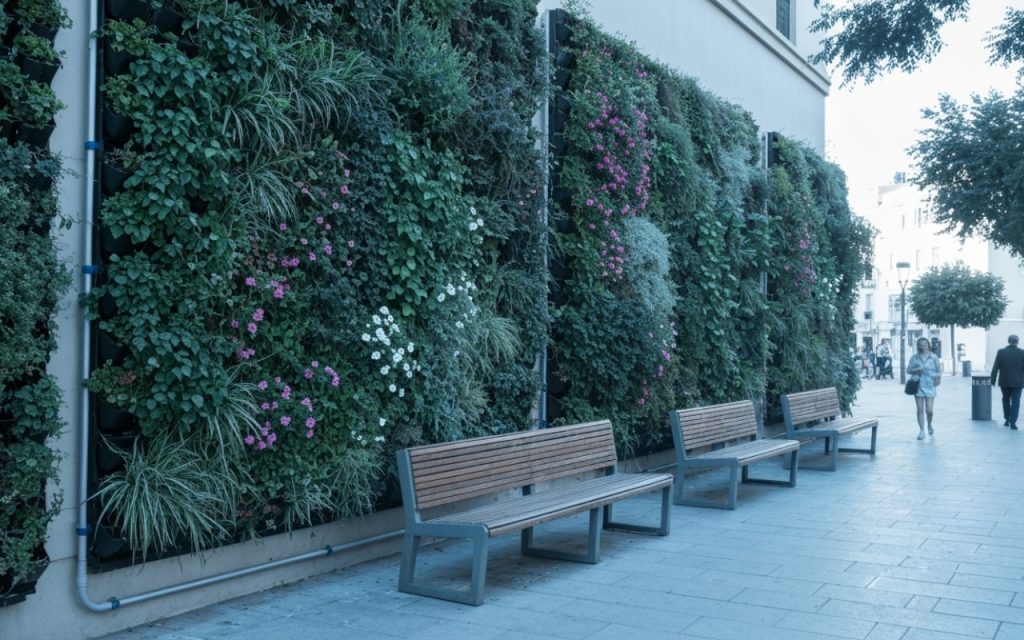
Natural living wall
We design, manufacture and install natural living walls: live plants on a technical envelope with its own substrate, irrigation and drainage. Our Fytotextile® system was developed with the University of Seville and has more than 17,000 m² installed across 22 countries. We work with architecture practices, contractors and developers from the design stage onwards.
Natural, artificial or preserved: the differences that matter
All three look alike in a photograph, but they are not comparable in performance or service life. Only one of them is a living system:
| Natural | Artificial | Preserved | |
|---|---|---|---|
| Vegetation | Live, growing plants | Plastic replica | Stabilised plant, no longer alive |
| Irrigation | Automated, with fertigation | Not required | Not required |
| Maintenance | Scheduled inspections and pruning | Surface cleaning | Stable environment, no water |
| Air quality | Filters NOx and particulates, fixes CO₂ | No contribution | No contribution |
| Thermal regulation | Shading and evapotranspiration | No | No |
| Outdoor use | Yes, with selected species | Limited: fades in sunlight | Not suitable |
| Service life | Indefinite with maintenance | UV degradation | Years, indoors only |
An artificial living wall answers a decorative need. A natural living wall also answers an environmental and energy need of the building, and it is the only one of the three that can contribute credits towards certifications such as LEED, BREEAM or WELL.
What a natural living wall delivers
What sets live vegetation apart is not how it looks, but that it works. These are the four effects that are actually measured in a project:
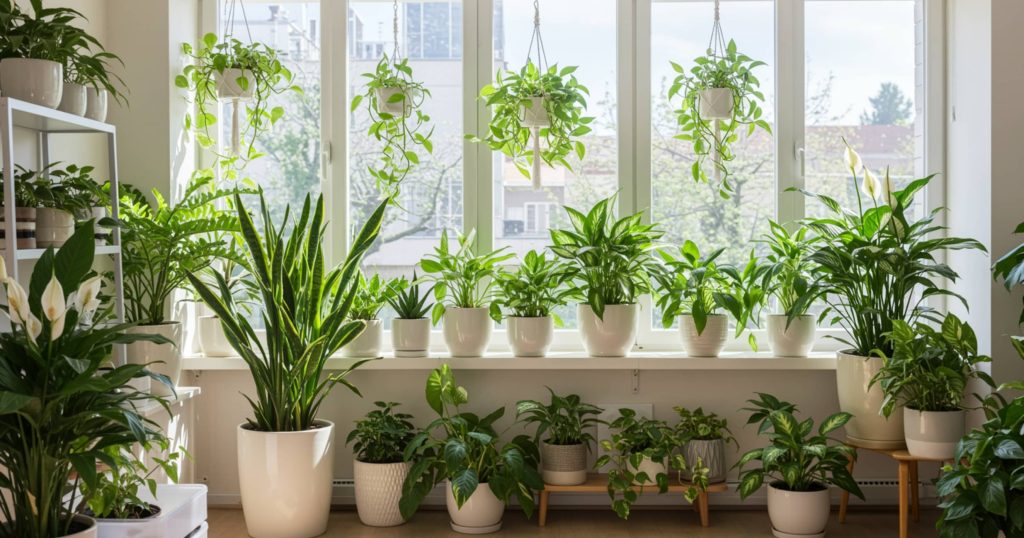
Air quality
Live vegetation filters NOx and airborne particulates (PM 2.5–10) and fixes CO₂. Indoors, the system is sized to renew the air of the space it sits in, not merely to decorate it.
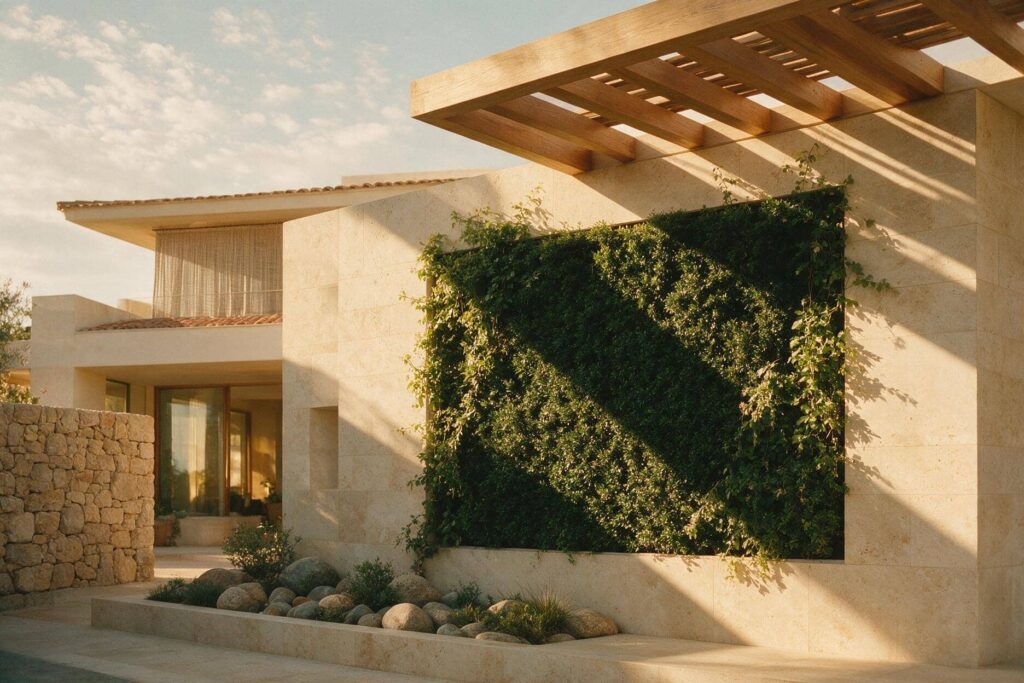
Thermal regulation
Shading of the wall plus the plants’ evapotranspiration cut the heat load on the facade in summer and soften heat loss in winter, with a direct effect on HVAC demand.
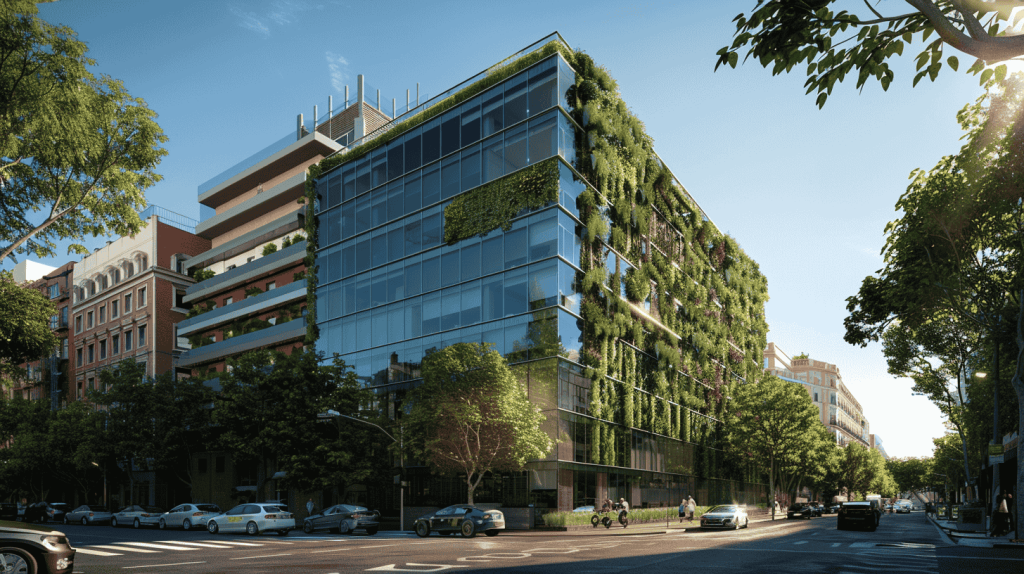
Urban biodiversity
A living wall provides shelter and food for pollinators and small urban fauna in dense settings, and connects isolated green areas where a ground-level garden simply does not fit.
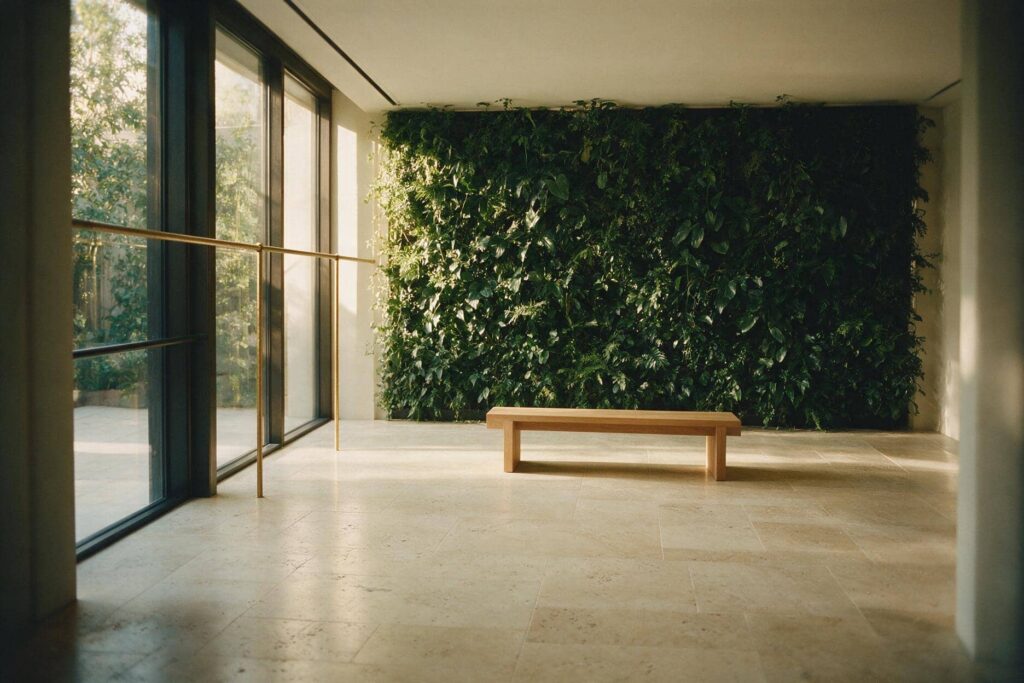
Wellbeing and asset value
Live vegetation in workplaces is associated with lower perceived stress and greater comfort, and it differentiates the building for occupiers, tenants and investors.
You can see each effect developed in full on our living wall benefits page.
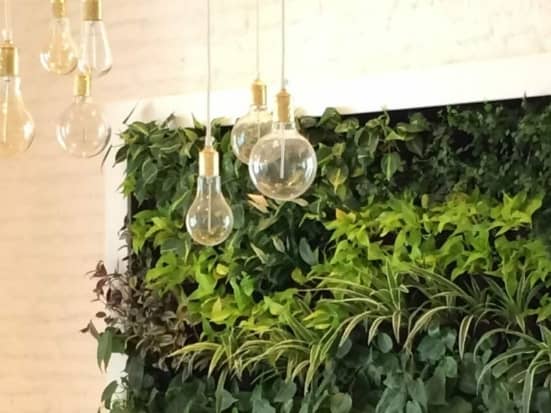
The systems we build natural living walls with
How the system works, layer by layer
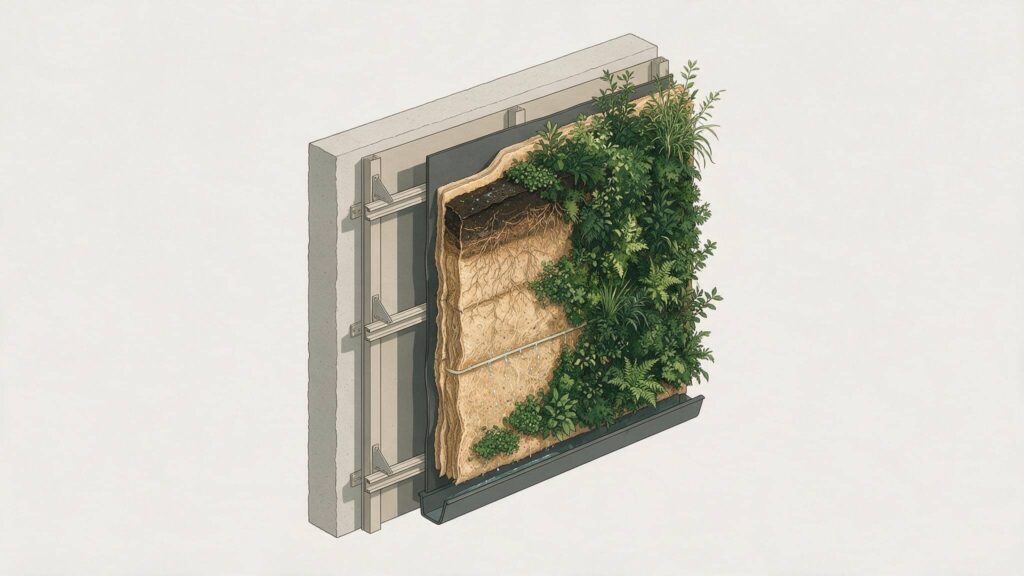
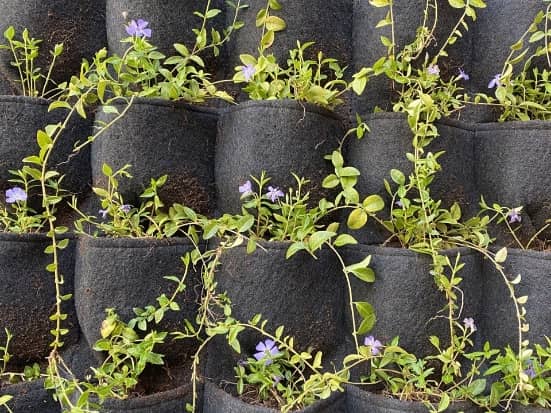
The system is built up in layers, fixed to an auxiliary structure that is independent of the supporting wall:
- Auxiliary structure: profiles anchored to the wall that separate the system from the substrate and create a ventilated cavity.
- Waterproof membrane: isolates the building fabric from the moisture of the planted system.
- Fytotextile® textile support: felt layers that host the root ball. They distribute water by capillarity and keep the assembly lightweight.
- Vegetation: species selected according to orientation, solar exposure and the local climate.
- Irrigation and fertigation: programmed drip lines delivering water and nutrients in precisely the right dose.
- Collection and drainage: a bottom channel that recovers the surplus and returns it to the circuit or to drainage.
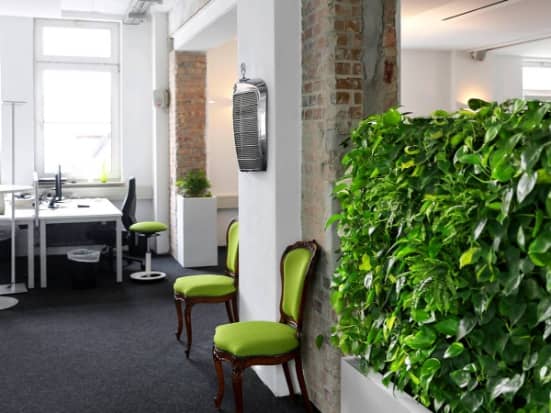
Indoors, where natural light is rarely enough to sustain the vegetation, the system is completed with auxiliary lighting sized to the photosynthetic needs of the chosen species. The two main applications are the outdoor living wall and the indoor living wall.
How we work with your project
Initial study
We analyse orientation, solar exposure, structural support and access to water and light at the specific site.
Plant selection by orientation
A palette of live species matched to the real exposure of each panel, not to a generic catalogue.
Technical documentation
Construction details, Revit families and DWG files, and priced items for your budget.
Manufacture, installation and maintenance
In-house production, technical installation with local partners and a scheduled maintenance plan.
Which plants go into a natural living wall
There is no universal palette: it is decided project by project from orientation, solar exposure, climate and wall height. As a reference, these are the families that perform best:
- Outdoors in a Mediterranean climate: Carex, Liriope, Lonicera, Trachelospermum, Rosmarinus and Teucrium, for their tolerance of strong sun and water stress.
- Outdoors facing north or in shade: Heuchera, Bergenia, Hedera, Vinca and hardy ferns.
- Indoors: Nephrolepis, Asplenium, Philodendron, Spathiphyllum, Chlorophytum, Epipremnum, suited to low light and stable temperatures.
The criteria are not only aesthetic: species of different habit and growth rate are combined so the wall covers quickly and stays dense over the years.
Maintaining a natural living wall
A natural living wall does need maintenance, and it is worth saying so plainly: it is a living system. What is true is that this maintenance is scheduled and bounded, not a daily chore.
- Irrigation and nutrition: automated. The controller adjusts dose and frequency by season, and fertigation supplies the nutrients the system cannot draw from natural soil.
- Technical inspections: periodic visits to check drip emitters, plant health and evenness of coverage.
- Pruning and replacement: containment pruning to keep the designed volume, plus occasional replacement of failed plants.
With a proper maintenance plan the service life of the system is indefinite: the vegetation renews itself and the textile support does not expire.
How much does a natural living wall cost?
Pricing is calculated per square metre of planted surface and covers the system, the plants, the irrigation and the installation. As an indicative reference, a natural living wall starts at €450–1,000/m².
Two factors push a budget towards the top of that range: artificial grow lighting in interiors with little natural light, common in corporate lobbies and office floors, and reinforcement of the irrigation system where summer exposure is severe. Maintenance is contracted separately, as an annual service, and is worth budgeting for from the start.
Frequently asked questions
How much does a natural living wall cost?
A natural living wall starts at €450–1,000/m². The range depends on the system, the total surface area, whether it is indoors or outdoors, and how automated the irrigation is. Indoor projects needing artificial grow lighting sit at the top of the range.
What is the difference between a natural and an artificial living wall?
The natural one is made of live plants with substrate and irrigation, and it improves air quality, regulates temperature and supports biodiversity. The artificial one is a plastic replica: no watering, no maintenance, and none of those environmental effects either. Outdoors it also fades under ultraviolet radiation.
Which plants work best in a natural living wall?
It depends on orientation and climate. Outdoors in a Mediterranean climate, Carex, Liriope, Lonicera, Trachelospermum, Rosmarinus or Teucrium work well; on shaded facades, Heuchera, Bergenia, Hedera, Vinca; indoors, ferns such as Nephrolepis and Asplenium alongside Spathiphyllum or Epipremnum.
How much maintenance does a natural living wall need?
Irrigation and nutrition are automated and monitored. Human maintenance comes down to periodic technical inspections, containment pruning and occasional plant replacement, within a scheduled annual plan.
Can a natural living wall be installed outdoors?
Yes, and it is one of its two main applications. It requires a prior study of solar exposure and orientation in order to select species suited to the real conditions of the site. You can see how we approach it on our outdoor living walls page.
Can a natural living wall help with LEED, BREEAM or WELL certification?
It can contribute credits towards those certifications through its effect on indoor air quality, thermal comfort, water management and biodiversity. It is the only one of the three variants — natural, artificial and preserved — that can, because the other two have no biological function.
REQUEST INFORMATION


