Choosing a living wall system is a structural and maintenance decision, not an aesthetic one. The system determines how much load the wall carries, which services have to reach it, how often someone has to get up there to look after it, and how many years it lasts. Two walls that look identical on handover day can behave very differently by their third summer.
Below are the families used in practice, with what each one solves well and what it does not.
The families of living wall systems
1. Climbers on a support structure
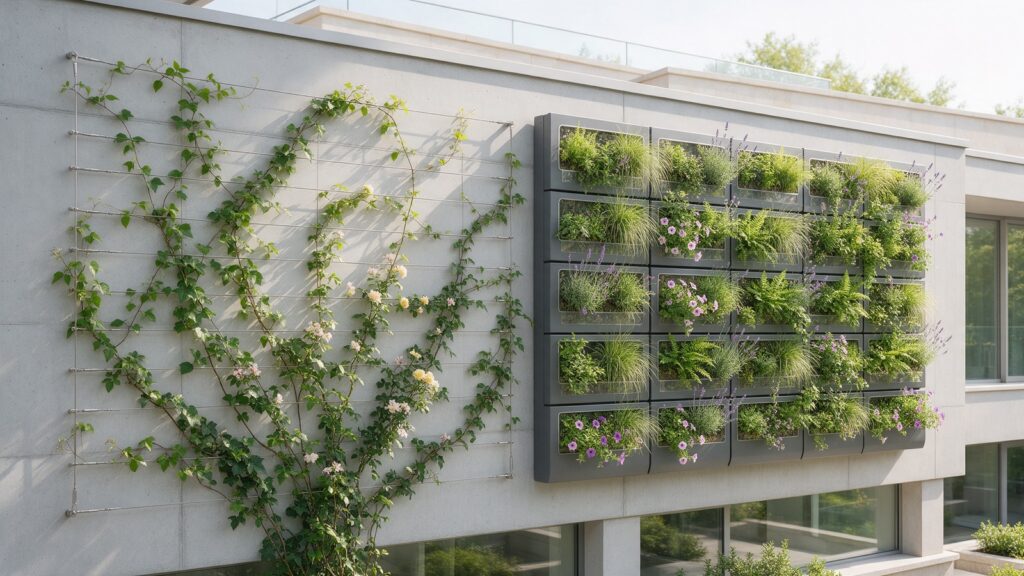
Planting is rooted in the ground or in planters at the base of the facade and climbs a trellis, cables or mesh. It is the cheapest option and the lightest on the wall, because the ground carries the weight rather than the envelope.
In exchange, full coverage takes years, the achievable height is limited, and the palette narrows to climbing species. It does not let you design with planting; it lets planting cover.
2. Modular systems on a textile carrier
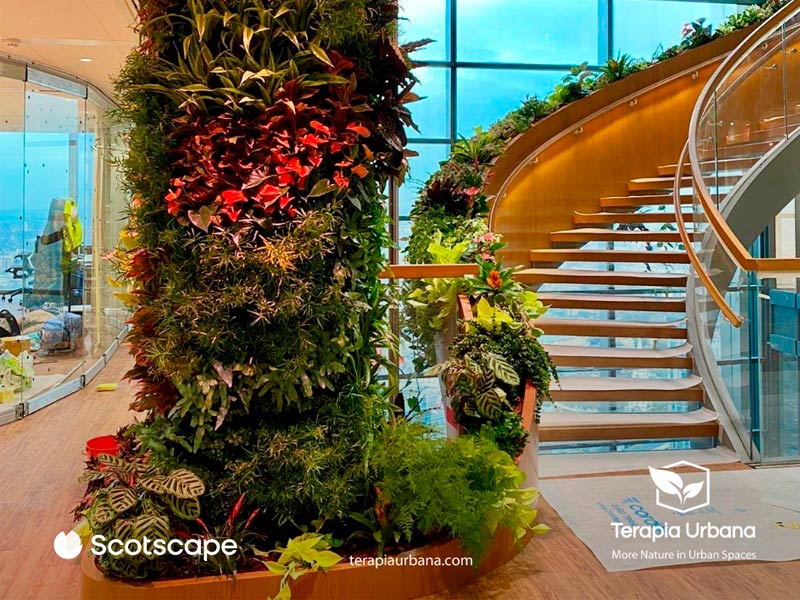
Plants grow in pockets or chambers of a multi-layer textile carrier fixed to a sub-frame anchored to the wall, with automated drip irrigation. This is the professional standard on facades and in interiors of any scale: full coverage from day one, an almost unrestricted plant palette, and the ability to design the planting pattern species by species.
It requires a calculated sub-frame, a water supply, power for the irrigation controller and maintenance access designed in from the start. It is the technology we work with: the Fytotextile® system.
3. Hydroponic systems without substrate
Roots develop on an inert carrier and all nutrition arrives dissolved in the irrigation water. These reduce weight and allow very precise control of nutrition, but dependence on the irrigation system is absolute: a prolonged failure leaves no margin, because there is no substrate holding a reserve.
4. Modular tray and pot systems
Plastic modules holding substrate, fixed to a structure. They are simple to install and to replace piece by piece, which makes them convenient on small areas. The downside: the grid of modules often stays visible through the planting, substrate volume per plant is limited, and outdoors the exposed plastic ages.
5. Free-standing systems, no building work
Where the wall cannot or should not be touched — leased premises, listed buildings, temporary fit-outs — there are systems that are not anchored at all: double-sided planted screens with an integrated tank and closed-circuit irrigation, or framed panels that work as a living canvas. All they need is good light and a power socket.
That is the category of Fytoscreen®, free-standing screens planted on both faces, and Slimgreenwall®, built into a fibreglass frame. Both run on Fytotextile® technology and need no building work.
6. Artificial walls and preserved moss
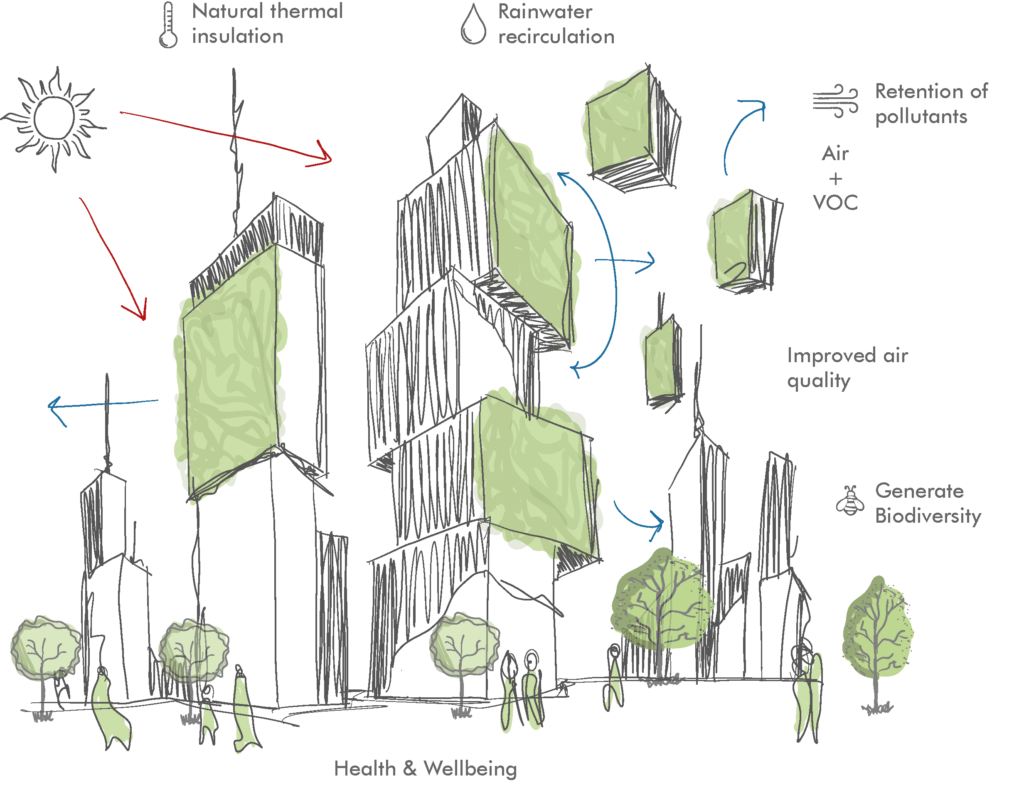
Worth naming, because they hold a large share of the market, and worth being plain about: they are not living walls, they are decorative cladding. No irrigation, no horticultural maintenance — and none of the effects that technically justify a green facade: evapotranspiration, thermal regulation, particulate capture, biodiversity. A valid answer when the brief is a green finish with no services; the wrong answer when the project is after environmental performance.
The five criteria that decide it
- Location: indoors or outdoors, and the orientation. It governs the plant palette before anything else, and indoors it forces the question of supplementary lighting.
- Load on the structure: always with the system water-saturated. In refurbishment this is usually the criterion that rules options out before anything else starts.
- Available services: whether water, drainage and power reach the wall. This is what separates an anchored system from a free-standing one.
- Maintenance access: a facade reachable only by cherry picker costs money for its entire service life. That is settled at design stage, not afterwards.
- Service life and total cost: not the installed price, but installation plus water, replanting and maintenance across the years.
For how the chosen system is resolved on the drawing, see the green wall construction detail; for the cost side, how to budget for a living wall.
Indoors and outdoors call for different systems
Outdoors the building physics lead: wind on the sub-frame, frost resistance, penetrations through the waterproofing, and a palette that survives the actual orientation — see outdoor living walls. Indoors the problem is different: light is rarely sufficient, moisture control and drainage shape the choice, and maintenance access tends to be tighter — see indoor living walls. A system that excels on a facade can be the wrong call in a lobby, and the reverse.
Frequently asked questions
What types of living wall systems are there?
Among living systems: climbers on a support structure, modular systems on a textile carrier, hydroponic systems without substrate, modular tray or pot systems, and free-standing systems needing no building work. Separately there are artificial cladding and preserved moss, which are not living plant systems.
Which system suits a facade best?
For full coverage and control of the planting design, modular systems on a textile carrier are the standard. Where budget governs and waiting years for coverage is acceptable, climbers on a support structure are a reasonable, minimal-load alternative.
Can a living wall be installed without building work?
Yes, with free-standing systems: planted screens or framed panels with closed-circuit irrigation. They need adequate light and a power socket, and they are the usual route in leased premises or buildings where intervention is restricted.
How long does a living wall last?
Far more dependent on maintenance and access than on the system itself. A well-chosen system with controlled irrigation and a maintenance plan that is actually followed gets renewed in parts and has no expiry date; one nobody can reach degrades quickly, whichever family it belongs to.
Not sure which family fits your project? Our technical consulting team assesses the substrate wall, the available services and the expected maintenance, and proposes the system that follows from it. Tell us about your project.